Boeing VC-25B – The Billion-Dollar Race for the “Flying White House”
As of late April 2026, the United States Air Force (USAF) has reached a critical juncture in the procurement of the Boeing VC-25B, the next-generation aircraft designated as Air Force One. In an unprecedented move, the Department of the Air Force’s FY2027 President’s Budget request has signaled a massive strategic pivot. While the world’s attention was captured by the news of a $300 million luxury 747-8 “gifted” by the Qatari royal family to serve as a bridge aircraft, the USAF is quietly asking for a staggering $732 million to rescue the core Boeing program.
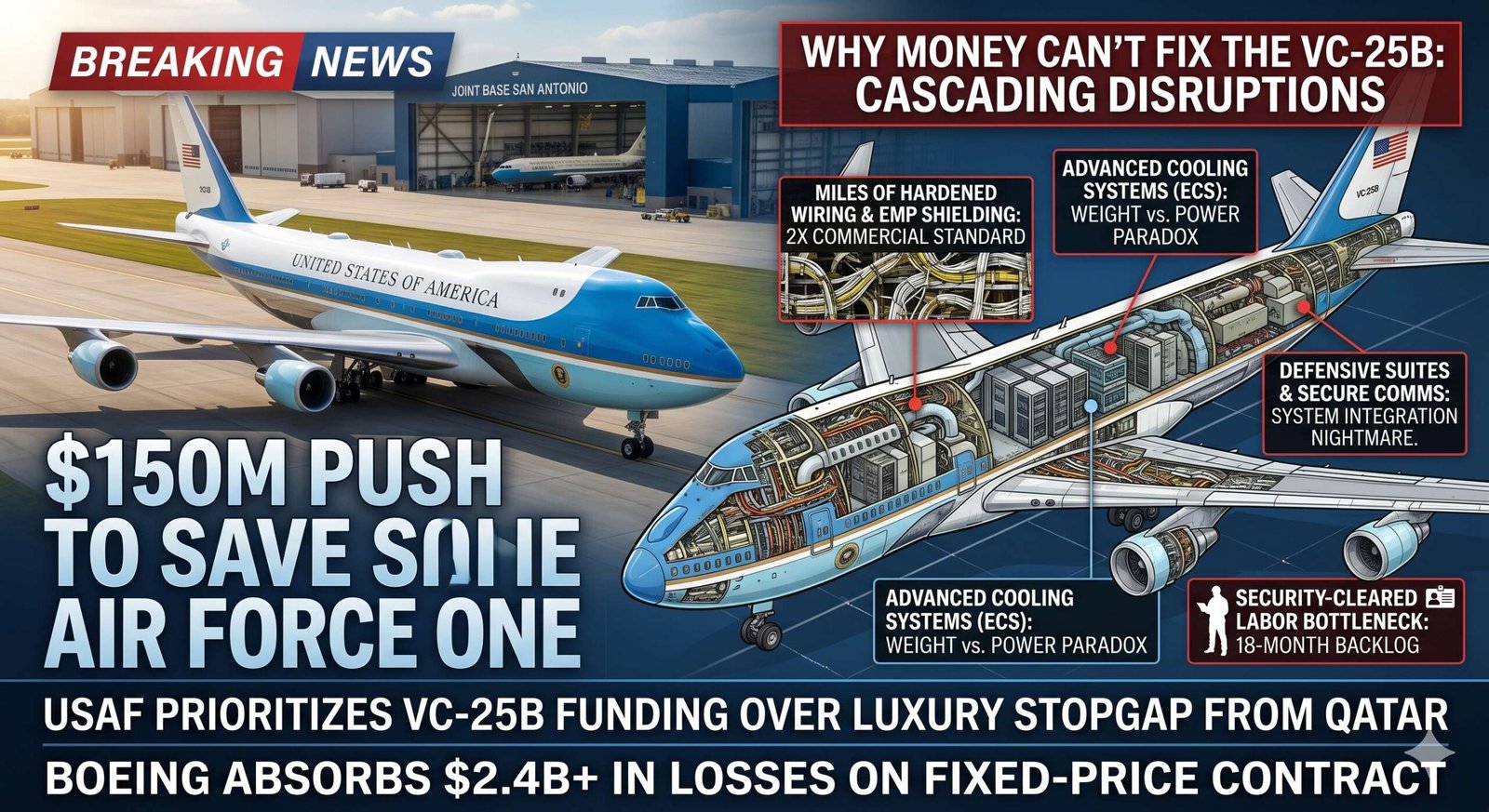
Central to this request is a $150 million “schedule protection” surge. This funding isn’t just about finishing a plane; it’s an aggressive intervention to stop the bleeding of a program that has already cost Boeing over $2.4 billion in losses. This deep-dive analysis explores the “Density Paradox” of defense engineering: why, in the world of high-stakes aerospace, money is often less valuable than time, and why the VC-25B has become the most difficult manufacturing challenge of the decade.
I. The “Time is Money” Logic: Analyzing the $150M Surge
In modern corporate strategy, there exists a “break-even” point where the cost of a delay exceeds the cost of a massive financial infusion. The Air Force One program passed that point in early 2025.
1. Stabilizing the 2028 Delivery Target
The original 2024 delivery date has long since vanished. Current projections now place the arrival of the first mission-ready VC-25B in mid-2028, with some analysts fearing a slip into 2029. The $150 million additional funding identified in the FY27 request is a “surgical” strike intended to:
Buy Parallel Progress: Hire additional security-cleared engineering teams to work on disparate systems (communications, cooling, and defensive) simultaneously rather than sequentially.
Incentivize Supplier Resilience: Provide “bridge funding” to critical Tier-2 and Tier-3 suppliers who have been pushed to the brink of bankruptcy by the program’s delays.
2. The Maintenance Crisis of the VC-25A
The urgency is driven by a hidden financial drain: the aging VC-25A. The two current presidential jets, tail numbers 28000 and 29000, have been flying since 1990.
Operating Costs: As of 2026, the cost to operate the VC-25A has surged beyond $200,000 per flight hour.
Parts Obsolescence: The Air Force is increasingly forced to “cannibalize” parts or commission bespoke manufacturing for components that Boeing no longer produces for the 747-200 airframe. The $150M surge is effectively a down payment to avoid a total grounding of the existing fleet.
II. Why Money Can’t Fix the VC-25B: The Engineering “Black Hole”
While the public often views Air Force One as a “luxury palace,” the Aerospace and defense industry views it as a flying fortress. The transition from a commercial Boeing 747-8i to a VC-25B involves technical challenges that cannot be solved by simply adding more capital.
1. The Wiring and EMP Shielding Paradox
The VC-25B requires miles of hardened wiring, literally hundreds of miles more than a standard commercial jet.
Signal Integrity: Because the plane must function as a mobile Command and Control (C2) center during a nuclear conflict, every wire must be shielded against Electromagnetic Pulse (EMP).
The “Signal Bleed” Crisis: A single microscopic abrasion in a wiring bundle can lead to “signal bleed,” where secure data interferes with flight controls. This requires a level of quality control that has proven nearly impossible to maintain at high production speeds.
2. Environmental Cooling Systems (ECS)
The massive server banks required for global secure communications generate an incredible amount of heat.
The Weight Trap: To cool these systems, the plane requires an industrial-grade ECS. However, every pound of cooling equipment reduces the plane’s range or requires structural reinforcement.
The “Cascading Disruption”: In 2025, a delay in the ECS design forced a total pause on the interior cabin installation, as the ducts and sensors had to be placed behind the bulkheads first.
III. The “Security-Cleared Labor” Bottleneck
One of the most significant factors in the Boeing VC-25B delay reasons is a factor money can only marginally influence: Cleared Labor.
The Clearance Wall: To work on Air Force One, every mechanic and janitor needs a Top Secret/SCI clearance. In 2026, the backlog for these clearances is nearly 18 months.
Staff Turnover: Boeing’s San Antonio facility has seen high turnover rates. When a cleared engineer leaves, it can take over a year to find and clear a replacement. No amount of “surge funding” can instantly produce a person with 20 years of avionics experience and a high-level government security clearance.
IV. Strategy: The Qatar “Bridge” and the “Fixed-Price” Error
The Qatar-donated 747-8 has become a strategic “safety valve” in the World news.
Pragmatic Continuity: President Trump has reportedly pushed for the Qatari jet to serve as a “bridge” aircraft by summer 2026.
Limited Scope: The USAF is pointedly not requesting funding to turn the Qatari jet into a full VC-25B. It will serve as a high-end transport with “standard” secure comms, but it will lack the hardened defensive suites of the “real” Air Force One. This prevents the USAF from “sinking” even more money into a third airframe while the primary project is still in the red.
Boeing’s $2.4B Strategic Error
Boeing CFO Jay Malave and the broader leadership have openly characterized the 2018 fixed-price contract as a strategic error.
The Risk Transfer: Usually, R&D projects of this complexity are “Cost-Plus.” By accepting a $3.9B fixed-price deal, Boeing took on 100% of the risk.
Leadership Pivot: The recent appointment of Steve Sullivan (formerly of the B-21 Raider program) to lead the VC-25B team represents Boeing’s “Aggressive Intervention” phase. Sullivan’s task is to apply the efficiency of the B-21 program to a project that is currently billions of dollars in the red.
V. Financial Post-Mortem and Market Impact
| Metric | Current Status (April 2026) | Strategic Impact |
| Total Acquisition Cost | $5.3 Billion+ | Highest per-unit cost for any transport aircraft. |
| Boeing Net Losses | $2.4 Billion (Accumulated) | Impacting Boeing’s overall R&D budget for commercial jets. |
| Projected Delivery | Mid-2028 | Creating a 4-year gap filled by the VC-25A and Qatari bridge. |
| First Flight Revised | March 2026 | 16 months behind the original “restructured” schedule. |
VI. Conclusion: The Luxury of Time vs. the Power of the Dollar
The $150M push to save Air Force One is a necessary, albeit painful, investment in the continuity of the American presidency. As the Iran war and global tensions continue to squeeze the Energy markets and aerospace supply chains, the USAF has realized that they cannot “wait out” the delays.
The VC-25B is a masterclass in why Aerospace leadership requires more than just capital, it requires a stable labor force, a resilient supply chain, and a realistic understanding of the limits of vertical integration. As the Qatari 747-8 takes flight this summer, and as Steve Sullivan attempts to right the ship in San Antonio, the world is watching to see if the “Flying White House” can finally cross the finish line by 2028.