As of late April 2026, the American retail landscape is witnessing a seismic shift. While traditional hypermarkets struggle with sprawling overhead and “decision fatigue” among consumers, Aldi Business Plan 2026 and has emerged as the definitive leader of the “efficient retail” movement. Today, Aldi is no longer just a “budget” grocery store; it has successfully rebranded as a lifestyle choice for the savvy, modern consumer.
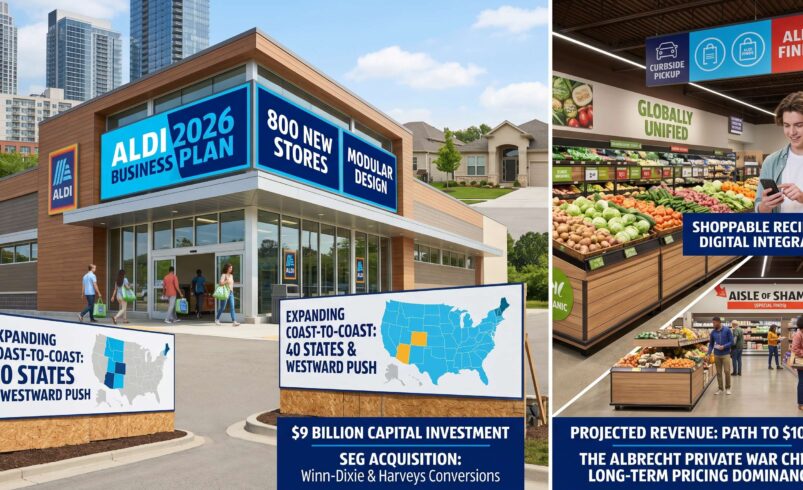
The 2026 business plan is the most aggressive in the company’s 50-year US history. Backed by a $9 billion capital investment, Aldi is executing a multi-pronged strategy: a revolutionary “Globally Unified” modular store format, a massive geographic expansion into the Western US, and a digital transformation that bridges the gap between the physical aisle and the smartphone screen. This report breaks down how these elements converge to put Aldi on a path to a $100 billion-plus revenue milestone.
II. The “Globally Unified” Modular Store Format
The centerpiece of today’s news is the official rollout of the Globally Unified Store Design. This isn’t just a fresh coat of paint; it is an engineering overhaul designed in partnership with the global design firm Landini Associates.
1. The Kit-of-Parts Logic
Historically, grocery stores were built as bespoke projects. In 2026, Aldi has moved to a “modular” system. By using a standardized “kit of parts” for refrigeration, shelving, and checkout systems, Aldi can now adapt its store layout to fit almost any building type.
Urban Integration: This allows Aldi to enter high-density cities like Chicago, New York, and Miami by fitting into the ground floor of existing high-rises.
Speed to Market: The modular design reduces construction and setup time by 30%, allowing Aldi to hit its target of 180+ new stores this year alone.
2. Wayfinding and Aesthetic Shift
Social media data from TikTok and Instagram in early 2026 showed that “aesthetic shopping” is a major driver for Gen Z and Millennial consumers. Aldi has responded by:
Natural Elements: Replacing industrial lighting with warm, natural wood accents and high-efficiency LED “daylighting.”
Fresh-First Layout: The produce section has been expanded by 20% and moved to the very front of the store to emphasize quality over “discount” perceptions.
Universal Iconography: Simplified, icon-based signage that is consistent across Aldi stores in the US, Germany, the UK, and Australia, ensuring a “Globally Unified” experience.
III. The $9 Billion Expansion Strategy
Aldi’s board has committed $9 billion over five years to solidify its position as the third-largest US grocer by store count, with a long-term goal of surpassing Kroger.
1. Conquering the Southeast (The SEG Acquisition)
A major pillar of the 2026 strategy is the integration of Southeastern Grocers (SEG). Aldi is currently in the process of converting nearly 80 Winn-Dixie and Harveys Supermarket locations into the Aldi format.
Real Estate Dominance: This move gives Aldi immediate access to prime real estate in the “Sun Belt”—Florida, Georgia, and Alabama—where population growth is highest.
Dual-Brand Strategy: While many stores are being converted, those that remain under the Winn-Dixie name are being optimized with Aldi’s private-label logistics to improve profitability.
2. Breaking the Mountain Barrier: Colorado and the West
April 2026 marks the official entry into the Rocky Mountain region.
The Colorado Push: Ground has been broken on a 50-store plan for the Denver and Colorado Springs areas.
Logistics Hubs: To support this, a new high-tech distribution center in Goodyear, Arizona, has gone online, serving as the gateway for Aldi’s push into Phoenix, Las Vegas, and eventually California.
The 40th State: With the opening of the Portland, Maine store this quarter, Aldi now officially operates in 40 US states.
IV. Net Worth and the “Private War Chest”
One of the most misunderstood aspects of Aldi’s business plan is its financial structure. Aldi is privately held by the Albrecht family, one of the wealthiest dynasties in the world.
Estimated Net Worth: In 2026, the combined wealth of the Albrecht heirs (split between Aldi Nord and Aldi Süd) is estimated to exceed $100 billion.
Long-Term Thinking: Unlike Walmart or Target, Aldi does not have to answer to Wall Street shareholders. This allows them to maintain “loss-leader” pricing on staples like organic milk and eggs for years, effectively starving out local competition who cannot afford to match their margins.
Reinvestment: Nearly 100% of profits are reinvested back into the $9B expansion plan, creating a self-funding growth engine.
V. Digital Innovation and the “Aisle of Shame”
Aldi has finally solved the “digital gap” that previously plagued the discount sector. The 2026 digital relaunch includes:
Shoppable Recipes: A new feature on the Aldi app where users can click a TikTok recipe and have all the ingredients added to a curbside pickup cart instantly.
The Virtual “Aisle of Shame”: The “Aldi Finds” middle aisle has a cult-like following on social media. Aldi now uses “Limited Drop” notifications on their app to create artificial scarcity, driving massive foot traffic every Wednesday when new items arrive.
ALDIgo Technology: Following successful pilots in 2025, Aldi is expanding its “Checkout-Free” stores in 15 major urban markets. Using AI ceiling sensors, shoppers can grab items and walk out, with the bill automatically sent to their Aldi app.
VI. Conclusion: The Path to $100B
The “Aldi Business Plan 2026” is a masterclass in operational efficiency and brand evolution. By combining a Modular Design that fits anywhere, a $9 Billion War Chest that outspends competitors, and a Digital Strategy that leans into social media culture, Aldi is no longer just a grocer—it is a tech-forward logistics company that happens to sell food.
By the end of 2028, with a projected 3,200 stores and revenue exceeding $100 billion, Aldi will likely be the dominant force in American retail, proving that in the modern economy, simplicity and speed are the ultimate luxuries.