Wren Kitchens Failed in America: The British Invasion That Retreated
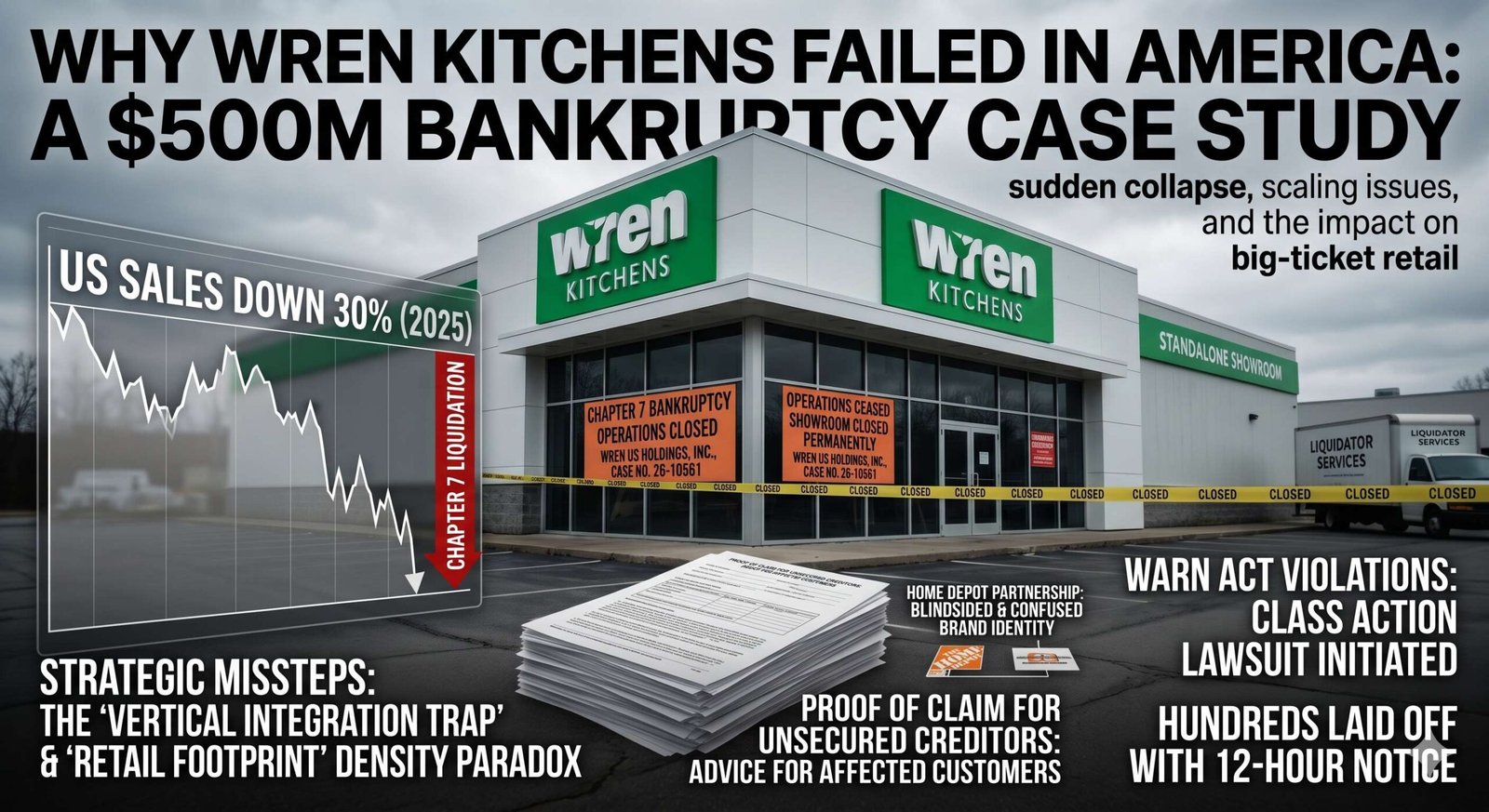
In the retail world, “The British are coming” is a phrase often met with both excitement and skepticism. From Tesco’s “Fresh & Easy” to Topshop, the history of UK brands attempting to conquer the United States is littered with expensive retreats. On April 24, 2026, Wren Kitchens joined this list in spectacular and devastating fashion.
By filing for Chapter 7 Bankruptcy, Wren didn’t just stumble; it liquidated. This wasn’t a reorganization; it was a total surrender. With assets and liabilities estimated between $100 million and $500 million, the sudden closure of 15 showrooms and a massive Pennsylvania manufacturing plant provides a masterclass in how even a billion-dollar parent company can misread a foreign market.
I. The “Abruptness” Factor: An Operational Blackout
The most striking element of the Wren collapse was its lack of transparency. In corporate finance, a “graceful exit” involves winding down operations, fulfilling existing orders, and providing severance. Wren chose the “Blackout Strategy.”
The Zoom Call: On April 23, hundreds of employees across the Northeast and Pennsylvania were summoned to a brief digital meeting. In under five minutes, they were told the company was insolvent and their health insurance would expire at midnight.
Customer Limbo: By the morning of April 24, homeowners who had spent $30,000 to $50,000 on kitchen remodels found showroom doors padlocked. The UK-based parent company, Wren Kitchens Limited, remained operational and profitable, but the U.S. arm was legally severed, leaving American customers as “unsecured creditors.”
II. Strategic Misstep: The Vertical Integration Trap
Wren’s success in the UK is built on Vertical Integration. They design it, make it, sell it, and deliver it. This works in a small, dense island like Great Britain. In the vast geography of the United States, this model became an anchor.
1. The Wilkes-Barre Burden
Wren invested tens of millions into a 314,000-square-foot manufacturing facility in Wilkes-Barre, Pennsylvania. In theory, this would save on shipping costs. In reality, it created a massive “Fixed Cost” burden. To reach a “break-even” point, that factory needed to be pumping out thousands of kitchens a week. With only 15 showrooms, the factory was operating at a fraction of its capacity, bleeding cash every single day.
2. The Logistics Nightmare
In the UK, a truck can cross the country in a day. In the U.S., managing a private fleet of specialized delivery vehicles across multiple states, each with different labor laws and road regulations, is a logistical specialty that Wren failed to master.
III. The Home Depot Paradox
The partnership with Home Depot was meant to be Wren’s “Trojan Horse.” By installing “Wren Kitchen Studios” inside Home Depot locations, they aimed to capture the massive DIY and “Pro” traffic.
Instead, the partnership became a Case Study in Brand Confusion:
Cannibalization: Customers often viewed Wren as a “premium” Home Depot product rather than a standalone specialist.
Liability Gaps: When an installation went wrong, Home Depot blamed Wren, and Wren blamed the independent contractors. This “blame game” destroyed the high-trust environment required for five-figure home renovations.
The Blindsided Partner: Home Depot’s public statement following the bankruptcy revealed they were not given advance notice, a move that has likely burned the bridge for any future UK brands seeking to partner with the American giant.
IV. Culture Clash: Understanding the American Homeowner
The American consumer does not buy kitchens the way the British consumer does. This cultural “lost in translation” moment was a primary driver of the $500M failure.
The Role of the General Contractor (GC): In the U.S., the GC is the gatekeeper. Wren attempted to bypass the GC by offering an all-in-one service. American contractors, feeling threatened or ignored by Wren’s model, steered their clients toward local custom shops or traditional distributors.
Design Expectations: Wren’s “Euro-style” sleekness is popular, but the American “Luxury” market still leans heavily toward Shaker-style and “American Classic” aesthetics with specific sizing requirements that Wren’s standardized UK templates struggled to match efficiently.
V. Financial Analysis: The “Burn Rate” of 2025
By mid-2025, the warning signs were flashing red. Internal reports suggested that US Sales were down 30% year-over-year.
| Revenue Stream | 2024 Performance | 2025 Performance | 2026 Forecast |
| Direct Sales | $140M | $98M | $0 (Liquidated) |
| Home Depot Studios | $60M | $42M | $0 (Liquidated) |
| Factory Overhead | ($45M) | ($52M) | N/A |
| Net Position | Loss | Severe Loss | Chapter 7 |
The UK parent company eventually reached a “Capital Exhaustion” point. Rather than pouring another $100M into a saturated and cooling U.S. housing market (affected by 2026’s high interest rates), they chose to “cut the limb to save the body.”
VI. Legal Fallout: The WARN Act and Creditor Rights
The bankruptcy filing has triggered a wave of litigation that will last years.
1. The WARN Act Class Action
The Worker Adjustment and Retraining Notification (WARN) Act requires employers with 100+ employees to provide 60 days’ notice of a mass layoff. Wren provided roughly 12 hours. The company will likely argue the “Faltering Business” exception, but legal experts suggest that because the UK parent is wealthy, the “veil” may be pierced to provide compensation to the hundreds of laid-off American workers.
2. The Consumer “Proof of Claim”
For the thousands of customers with half-finished kitchens, the Latest news is grim. In a Chapter 7 liquidation, the order of payout is:
Secured Creditors (Banks/Lenders)
Administrative Expenses (Lawyers/Trustees)
Unsecured Creditors (Customers/Suppliers)
Customers are at the bottom. This bankruptcy serves as a warning to always pay for major home renovations via Credit Card, which allows for a “Section 75” or “Chargeback” dispute that is often the only way to recover funds from an insolvent merchant.
VII. Conclusion: Lessons for the Global Executive
The failure of Wren Kitchens in America is not a story of a bad product, Wren makes excellent kitchens. It is a story of Strategic Rigidity.
The Lessons:
Avoid the “Factory First” Strategy: Do not build a massive manufacturing footprint until the retail demand is proven. “Scaling for the sake of scale” is a fast track to Chapter 7.
Localize the Business Model, Not Just the Product: Wren changed their cabinet sizes for the U.S., but they didn’t change their “Closed Loop” business model to fit American contractor culture.
Exit with Integrity: The “Blackout Exit” has decimated Wren’s global reputation. While they saved money on severance today, the loss of trust with global partners like Home Depot will cost them billions in future international opportunities.
As the dust settles in Wilkes-Barre, the empty Wren showrooms stand as monuments to the “Density Paradox”, you cannot win the American market with a “light” footprint and “heavy” overhead.
Further Information for Stakeholders
Employees: Seek legal counsel regarding the WARN Act.
Customers: Contact your credit card issuer immediately to file a dispute for “Services Not Rendered.”
Suppliers: File a Proof of Claim via the Delaware Bankruptcy Court portal for Case No. 26-10581.
Wren Kitchens US Bankruptcy – News Coverage Archive
Disclaimer: This analysis is based on the 2026 Chapter 7 filing and available market data. Financial figures are estimates based on court filings.