I. Lufthansa Cuts 20,000 Flights:- The Context: A Industry on the Brink
As of late April 2026, the Aerospace and Defense industry is grappling with its most severe supply chain and cost disruption in decades. The catalyst is the Iran war, which erupted in late February 2026, dragging the Iran government into a direct military confrontation with the U.S. and Israel. This conflict has fundamentally broken the Energy markets, as the effective closure of the Strait of Hormuz by Iran has strangled the flow of crude oil and jet fuel to Europe.
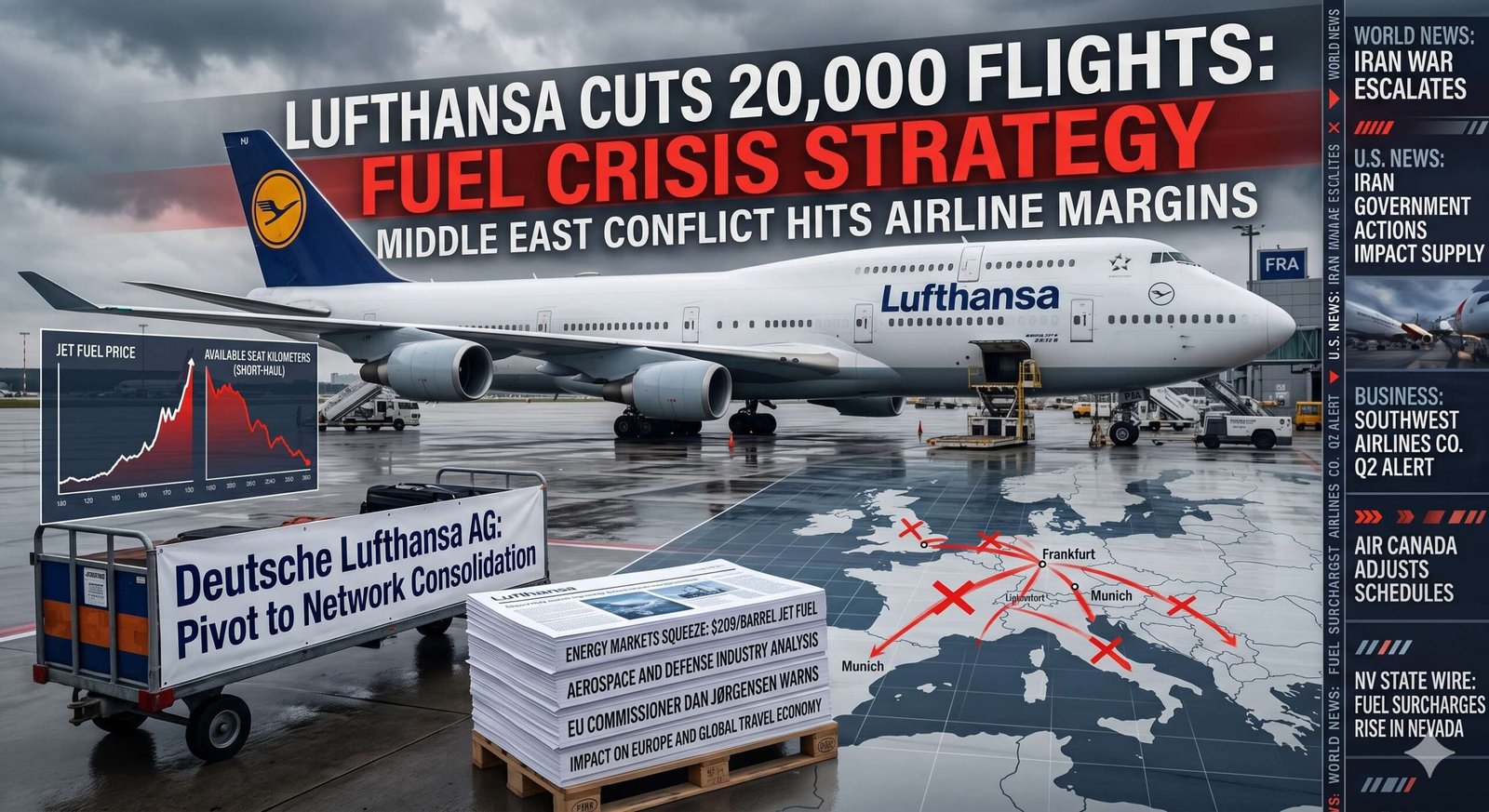
Deutsche Lufthansa AG, a titan of the European skies, has become the face of this crisis. On April 23, 2026, the carrier confirmed it would remove 20,000 short-haul flights from its summer and autumn schedule. This is not a mere seasonal adjustment; it is a defensive maneuver against a global jet fuel price that has more than doubled, hitting approximately $209 per barrel.
II. The Anatomy of the 20,000-Flight Cut
The “Lufthansa Strategy” involves a high-stakes surgical removal of capacity to preserve the company’s financial health.
1. The Hub-and-Spoke Consolidation
The majority of these cuts are centered on Lufthansa’s primary hubs in Frankfurt and Munich. By cancelling short-haul feeder flights, the airline is concentrating its limited fuel reserves on high-margin long-haul routes.
Saving the Fuel: This move is expected to save 40,000 metric tonnes of kerosene.
Route Suspensions: Regional links to cities like Stuttgart, Gdańsk, and Ljubljana are being temporarily suspended, forcing passengers toward rail alternatives or fewer, more crowded flights.
2. Closing the CityLine Subsidiary
A significant portion of these cuts was achieved through the total shutdown of Lufthansa CityLine, the group’s regional subsidiary. By retiring its 27 operational aircraft, Lufthansa is removing its most fuel-inefficient fleet members, focusing instead on its modern narrow-body jets.
III. Strategic Analysis: Business vs. Global Politics
The Business logic here is clear: stop the bleed. For a company like Deutsche Lufthansa AG, fuel typically accounts for 25–30% of operating costs. When those costs jump 100%, traditional profit margins vanish.
1. The EU Response: Dan Jørgensen’s Warning
Dan Jørgensen, the EU Commissioner for Energy and Housing, has been vocal in World news regarding the severity of this crisis. Speaking on April 22, he compared the current situation to the 1973 and 2022 energy shocks combined.
“This is not a short-term, small increase in prices,” Jørgensen warned. “It is a crisis of both price and, potentially, security of supply.”
2. The North American Ripple Effect
While the most acute shortages are in Europe, the impact is a major story in U.S. news and Canada.
Southwest Airlines Co. has already alerted investors that Q2 earnings will fall below estimates due to the 95% spike in North American jet fuel costs.
Air Canada and other major carriers are watching the NV State Wire and other regional news outlets closely as fuel surcharges become the new norm for travelers in states like Nevada and beyond.
IV. Financial Health: Protecting the Net Worth
In the General news, the focus is often on traveler frustration, but the Business story is about the “Private War Chest.”
Lufthansa’s Resilience: By proactively cutting 20,000 flights, Lufthansa is protecting its cash reserves (estimated at €8.5 billion).
Investor Outlook: Market analysts suggest that while capacity is falling by 1%, the load factors (percentage of seats filled) on the remaining flights will hit record highs, allowing Lufthansa to offset fuel costs with premium pricing.
V. Conclusion: The New Era of “Aviation Realism”
The Iran war has proved that fossil-fuel dependence is the greatest vulnerability for the modern airline. As the Iran government maintains its grip on the Strait of Hormuz, the aviation sector is moving toward a smaller, more expensive, and more “hub-centric” model.
Whether you are watching the news from a boardroom in Frankfurt, a travel desk in Nevada, or a government office in Iran, the message is the same: the age of cheap, abundant air travel is on pause. Lufthansa’s 20,000-flight cut is just the first page in a new manual for global aviation survival.